Kitchen Exhaust Compliance: A Guide for Facility Managers and Kitchen Operators
A guide by SAIS Hygiene, Australia’s specialist kitchen exhaust and HVAC cleaning provider since 2003.

In This Guide
- Understanding Compliance Responsibilities
- The Risk That’s Easy to Overlook
- What the Standards Actually Require
- The Anatomy of a Kitchen Exhaust System
- What a Proper Kitchen Exhaust Clean Looks Like
- Is Your Current Provider Meeting the Standard?
- The Multi-Site Challenge
- What Owner/Operators Should Do
- Questions to Ask Your Provider
- About SAIS Hygiene
- Get a Free Assessment
At a Glance
Commercial kitchen exhaust systems can accumulate grease over time, particularly in high-volume cooking environments. If not managed, this build-up can contribute to fire risk, reduced system performance, and maintenance issues.
Regular cleaning forms part of a broader maintenance and compliance approach. This guide outlines what operators should understand about kitchen exhaust cleaning, typical expectations, and how to manage risk and compliance obligations effectively.
Short on time? Skip straight to Section 5: the provider evaluation checklist. It’ll tell you in five minutes whether your current arrangement is protecting you or giving you a false sense of security.
Understanding Compliance Responsibilities
Responsibility for compliance typically sits with the building owner or occupier, even where services are outsourced to third-party providers.
Kitchen exhaust cleaning is one component of broader compliance obligations for commercial kitchens.
Depending on your site, these obligations may also include:
- System design and installation standards
- Fire protection systems (e.g. suppression systems)
- Inspection and maintenance regimes
- Record keeping and documentation
Cleaning alone does not constitute full compliance, but it plays an important role in maintaining system safety and performance.
← Back to topThe Risk That’s Easy to Overlook
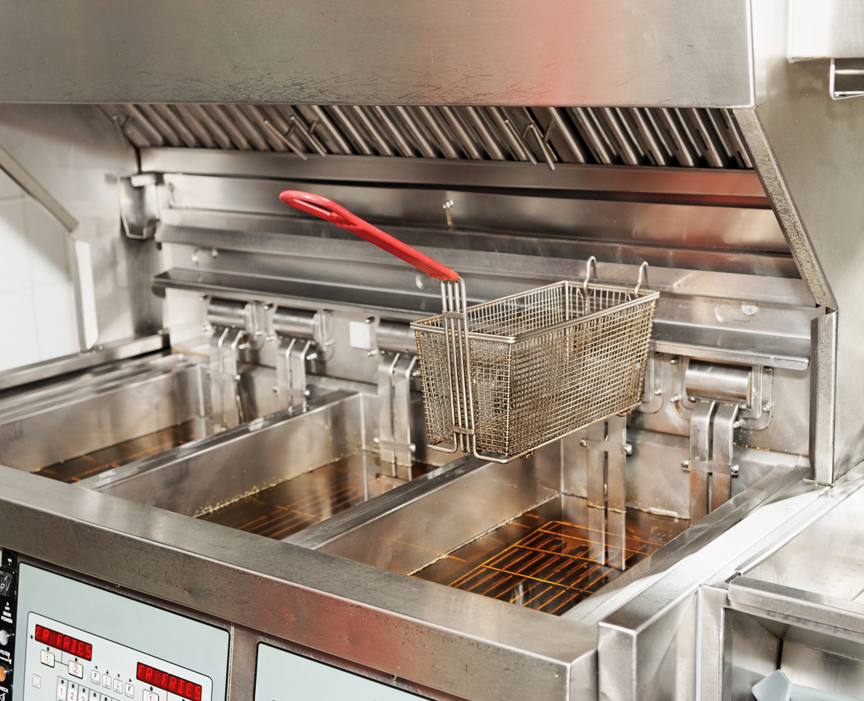
Grease build-up within kitchen exhaust systems is widely recognised as a potential fire risk in commercial kitchens.
When grease accumulates in ductwork and extraction systems, it can become a fuel source if exposed to heat or flame. Regular cleaning helps reduce this risk as part of an overall fire safety approach.
The risk in numbers
- The most common fires involve unattended cooking, overheating of cooking oil or fat, and the ignition of fatty residues within range hoods and ducting. Source: Fire and Rescue NSW, Fact Sheet 31
- Duct fires can be intense and reach temperatures of 1,000°C within minutes. The temperature is hot enough to ignite nearby combustible materials outside of the duct, via radiant heat transmission. Source: AIRAH Best Practice Guideline, Commercial Kitchen Exhaust Management
- According to Chubb, citing the NFPA, cooking equipment causes approximately 61% of restaurant fires. Chubb also notes that fires can rapidly spread when grease has accumulated inside exhaust hoods and ducts. Source: Chubb Australia, Commercial Kitchens Fire Protection
What’s at stake
A current compliance certificate showing the system was cleaned and documentation aligned with AS 1851-2012 will assist in demonstrating a proactive maintenance approach. Without one, fire safety authorities may issue notices, fines, or require remediation before continued operation, and if a fire occurs, the consequences escalate rapidly.
Most commercial property insurance policies also require that kitchen exhaust is maintained to the relevant Australian Standard. If it isn’t, and a fire occurs, the insurer will likely consider maintenance records when assessing a claim. The premium you’re paying assumes the system is being maintained. If the documentation doesn’t demonstrate it, the policy may not respond the way you expect.
From the field
In high-use kitchens, grease accumulation can occur more quickly than expected — particularly where cooking volume has increased over time.
We often see systems where cleaning frequency has not kept pace with usage, leading to significant build-up in ductwork and fans that is not visible from the kitchen.
What the Standards Actually Require (And What Most Operators Get Wrong)
AS 1851 is commonly referenced in Australia for the routine servicing of fire protection systems and is often used as a benchmark for maintenance documentation.
Cleaning records aligned with recognised standards can assist in demonstrating a proactive maintenance approach, however requirements may vary depending on the specific site and system.
In practical terms, cleaning frequency is generally determined by the type and volume of cooking being done. A charcoal chicken shop producing heavy grease output every day will typically need more frequent cleaning than a school cafeteria doing light meal prep.
How often does your system need cleaning? (illustrative guidance)
| Grease Level | Examples | Frequency |
|---|---|---|
| Extreme | Charcoal chicken, flame grills, solid fuel | Fortnightly to monthly |
| Heavy | QSR / fast food, deep fryers, burger kitchens | Monthly to quarterly |
| High | Wok cooking, Asian kitchens, high turnover | Monthly to quarterly |
| Moderate | Standard restaurants, à la carte, bistros | Quarterly to 6-monthly |
| Light | Cafes, school canteens, aged care, light prep | Annually (minimum) |
Cleaning frequency should be based on actual kitchen usage, cooking type, and system design.
The ranges above provide general guidance only. A site-specific assessment is recommended to determine appropriate cleaning intervals, particularly for high-volume or specialised operations.
Where most operators get it wrong
These are the most common compliance gaps we see when taking over a system from another provider. There are good operators in our industry, but these are the issues that put facility managers at risk:
Cleaning the canopy but not the ductwork. This is one of the most common issues we see. The canopy (the visible hood above the cooking line) gets cleaned because it’s the part everyone can see and easy to access. But the ductwork behind it, which runs through the ceiling to the exhaust fan, is where the real fire risk accumulates. If your provider isn’t opening access panels and cleaning the full length of the ductwork for grease and combustible residues, the job isn’t done.
Missing or inadequate access panels. To clean ductwork properly, technicians need physical access to the interior of the duct at multiple points along its length. Many older systems were installed without sufficient access panels, or the panels have been sealed over or obstructed during renovations. Another common observation is that access panels installed are too small to practically remove the debris. If a technician can’t physically reach inside the duct, they can’t clean it. A provider who doesn’t flag this is a provider who isn’t doing a thorough job. It is typically the responsibility of the owner or occupier to ensure that the full exhaust system is accessible for cleaning. It is the responsibility of the cleaning provider to advise when there are sections that are not accessible. A good cleaning provider should also be able to assist in the remediation of inaccessible sections.
No photographic documentation. A proper clean should be documented with photographs taken before, during, and after the work. This creates an evidence trail that demonstrates the condition of the system before cleaning and confirms the standard achieved. If your current provider doesn’t photograph the work, how do you verify it was done?
Certificates that don’t reference the correct standard. A generic “cleaning certificate” that doesn’t specifically reference AS 1851-2012 may not satisfy a fire inspector or insurer. The documentation should clearly state the standard the work was performed to, the date, the areas cleaned, and the technician’s details.
Cleaning schedules that don’t match the operation. Under AS 1851, the responsibility for maintaining fire protection systems — including kitchen exhaust systems — sits with the building owner or occupier. This includes ensuring that maintenance frequencies remain appropriate for the level of risk. While baseline cleaning frequencies are often set at the start of a contract, they are not intended to be fixed indefinitely. Changes in cooking volume, menu type, equipment, or trading hours can all increase grease accumulation and, in turn, fire risk. For this reason, cleaning frequency should be periodically reviewed against actual usage, rather than relying solely on the original schedule.
From the field
In high-use kitchens, grease accumulation can occur faster than expected — particularly where operations have scaled over time. It is not uncommon to see systems where cleaning frequency has not kept pace with usage, resulting in build-up in ductwork and fans that is not visible from the kitchen.
Shared responsibility: Service providers play an important role in identifying visible conditions and recommending adjustments. However, the ultimate responsibility for ensuring maintenance remains appropriate sits with the operator, who is best placed to understand how the kitchen is being used day-to-day.
Get a Kitchen Exhaust Cleaning Quote
Tell us about your site and we’ll provide a tailored quote, including recommended cleaning frequency, full scope of work, and transparent pricing.
Get a Free QuoteThe Anatomy of a Kitchen Exhaust System (Beyond What You Can See)
Understanding the components of your exhaust system matters. It’s the only way to know whether the service you’re receiving covers the full system or just the parts you can see. A commercial kitchen exhaust system has five main components, and a proper clean must address all of them.
| Component | Where It Sits | Why It Matters |
|---|---|---|
| Canopy (hood) | Above the cooking equipment | Entry point. Visible, but only a fraction of the system |
| Grease filters | Inside the canopy | Capture some grease; the rest passes into the ductwork |
| Ductwork | Ceiling/roof cavity | Primary fire hazard. Enclosed, out of sight, often neglected |
| Access panels | Along the ductwork | Without them, the duct can’t be cleaned or inspected |
| Exhaust fan | Rooftop (usually) | Drives the whole system. Frequently overlooked |
The canopy (hood)
The canopy is the large metal hood above the cooking equipment. It captures grease-laden vapours, steam, and smoke, directing them into the exhaust system. It’s the most visible part and the part that gets the most attention, but it’s only the entry point. Grease accumulates on interior surfaces, lip edges, and light fittings. Cleaning the canopy matters, but it’s a fraction of the total job.
Grease filters
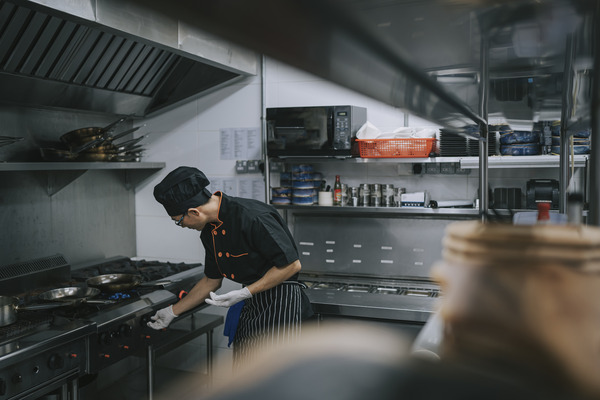
Baffle or honeycomb-style filters sit inside the canopy and capture a portion of grease before it enters the ductwork. Regular cleaning of filters is one of the simplest ways to minimise grease entering the ductwork, as clean filters operate more effectively than those that are saturated. Many kitchens clean these in-house. That’s good practice, but filters only stop a percentage. The rest passes through. Filters that are damaged, incorrectly fitted, or wrong for the cooking type let even more through. A good provider will assess your filters and flag replacements when needed.
Ductwork
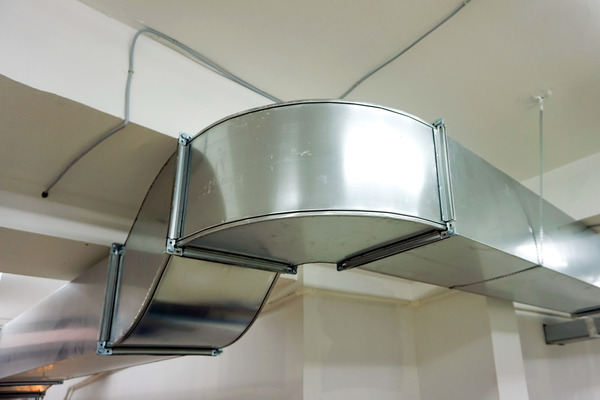
This is a key area where fire can easily spread if grease has accumulated. The ductwork is the enclosed metal channel running from behind the canopy, through the ceiling space, up to the exhaust fan on the roof. It can run for many metres with bends, junctions, and vertical risers. Every interior surface accumulates grease over time, and because it’s enclosed and out of sight, it’s the component most often neglected. A provider who cleans the canopy and filters but doesn’t access the full ductwork is leaving the primary fire hazard in place.
Proper ductwork cleaning means opening every access panel and cleaning interior surfaces to remove grease and combustible residues to the extent reasonably practicable. This level of cleaning is generally expected to support compliance with AS 1851-2012, and the standard a fire inspector will assess against.
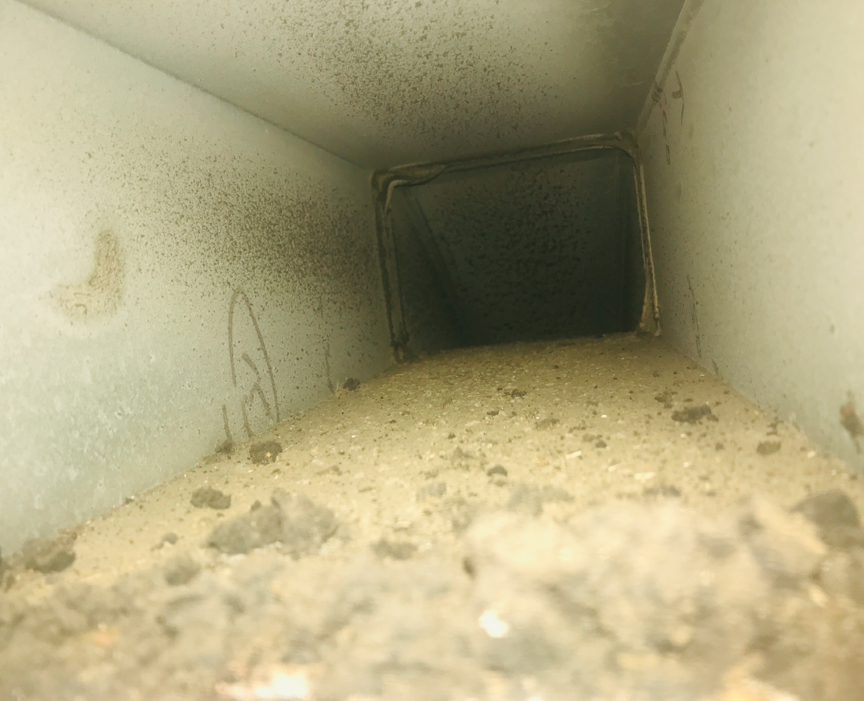
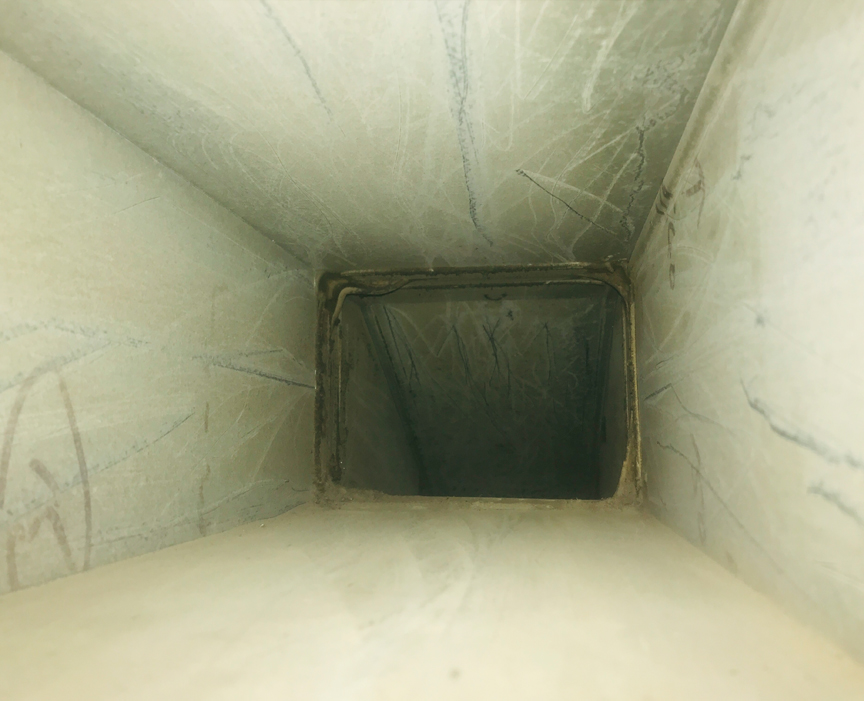
Ductwork before and after a full SAIS Hygiene clean. Grease and combustible residues removed to the extent reasonably practicable.
Access panels
Access panels are openings at intervals along the ductwork that let technicians physically reach inside. Without them, the duct can’t be properly cleaned or inspected. A well-designed system has panels at regular intervals, at every change of direction, and at both ends of the run. Many older systems don’t.
When we assess a system for the first time, access panel adequacy is one of the first things we check. If panels are missing, too small or blocked, we flag it and can often install them as part of a system remediation scope. If your current provider has never raised this with you, it’s worth asking whether they’re reaching the full length of your ductwork.
Exhaust fan
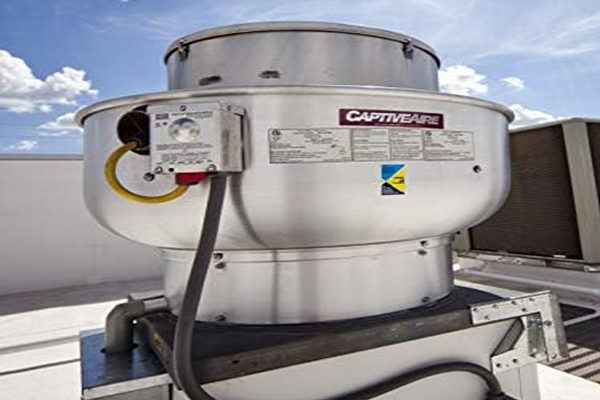
At the top of the system, usually on the roof, the exhaust fan creates the airflow that pulls air through the canopy, ductwork, and out of the building. Grease accumulates on its blades, housing, and motor, reducing efficiency, increasing energy use, and adding fire risk. It’s frequently overlooked because it’s out of sight. A complete kitchen exhaust system clean includes the fan. If it’s not in your provider’s scope, it should be.
The full picture
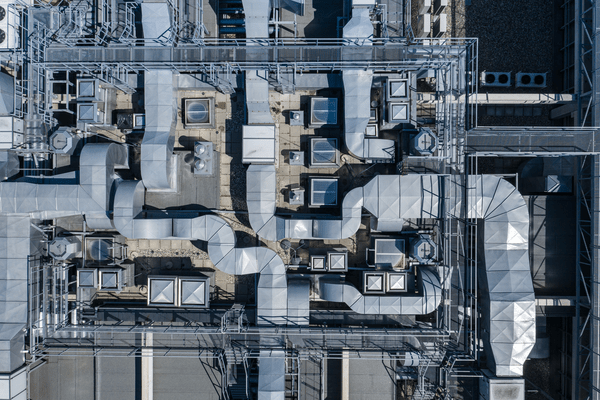
Now that you know the five components individually, step back and consider what the full system looks like from above. This is the infrastructure running across a commercial building rooftop, most of it completely hidden from anyone working in the kitchen below.
What a Proper Kitchen Exhaust Clean Actually Looks Like
This is what you should expect from a professional kitchen exhaust clean. If any of these steps are missing from your current service, it’s worth asking why.
Before the technicians arrive
A proper job starts before anyone sets foot on site. The provider should have already assessed the system (either from a previous clean or from an initial site visit), confirmed the scope, scheduled the work around your operating hours, and briefed the technicians on the specific requirements of your site.
For most commercial kitchens, exhaust cleaning is done after hours, late at night or early morning, to avoid disrupting service. This means the provider needs to be set up for after-hours work, with teams who are experienced at working in and around commercial kitchen environments outside of normal business hours.
Step 1: Site preparation
The technicians arrive and prepare the work area. This includes laying protective coverings over cooking equipment, benchtops, and floors to prevent any contamination. The kitchen should be left in the same condition it was found. A professional clean doesn’t create a mess for your kitchen team to deal with the next morning.
Step 2: System inspection
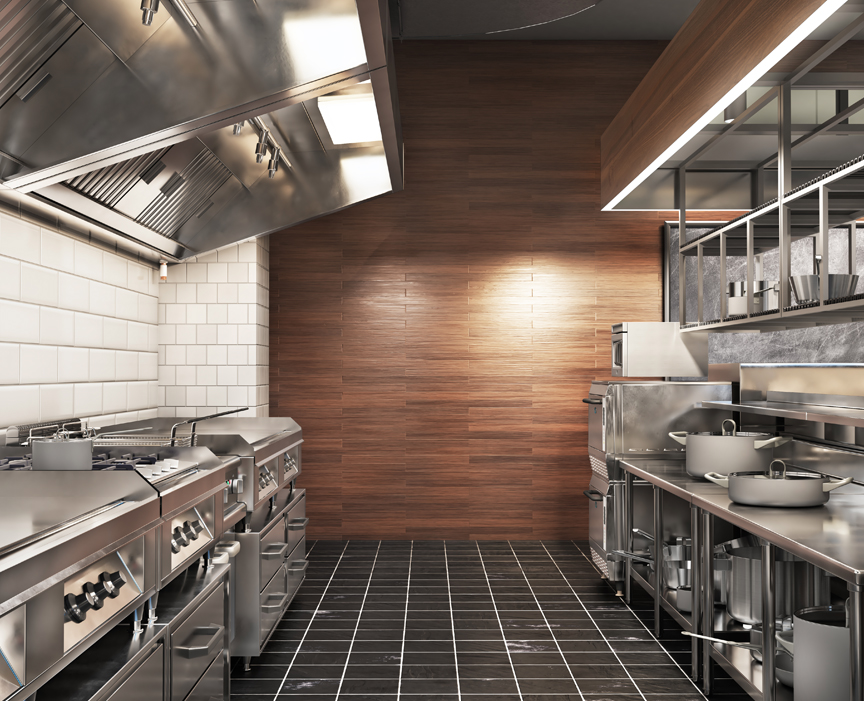
Before cleaning begins, the technicians inspect the system, checking the canopy, filters, access panels, ductwork, and exhaust fan. This initial inspection establishes the condition of the system and identifies any issues, such as damaged components, missing access panels, or excessive build-up that may require additional work.
This is also when the “before” photographs are taken. These photos document the condition of every part of the system prior to cleaning and form part of the compliance record.
Step 3: Filter removal and canopy cleaning
Grease filters are removed from the canopy and set aside. Given this is often part of internal staff routines (daily or weekly) cleaning will often be out of scope. If required, please ensure this is included in the proposal scope. Damaged or worn filters should be flagged for replacement. With the filters out, the canopy interior and exterior are cleaned thoroughly, with all grease removed from internal surfaces, light fittings, lip edges, and the plenum or canopy chamber (the space behind the filters where grease accumulates before entering the ductwork). This goes well beyond a surface wipe.
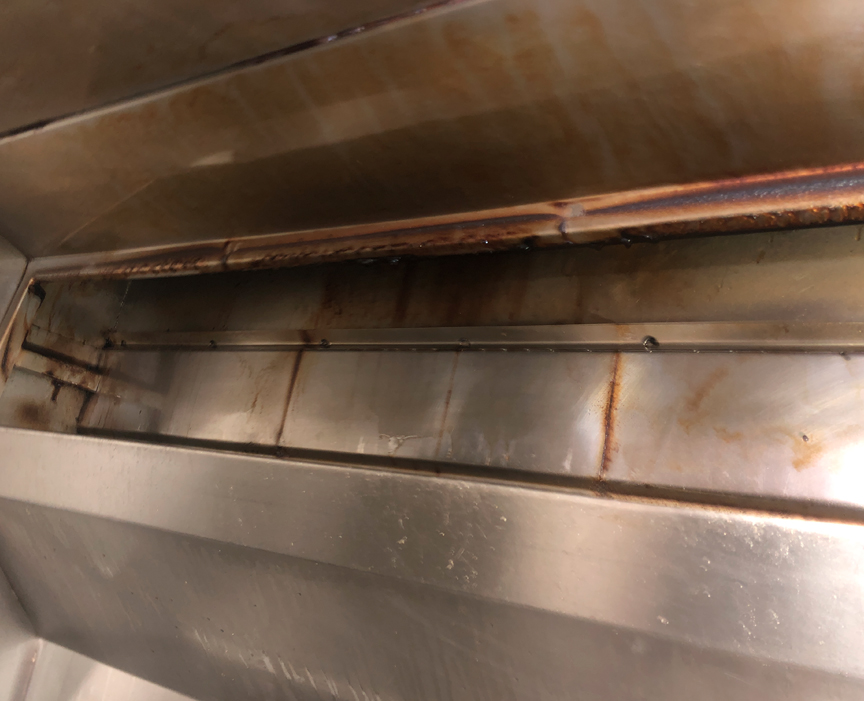
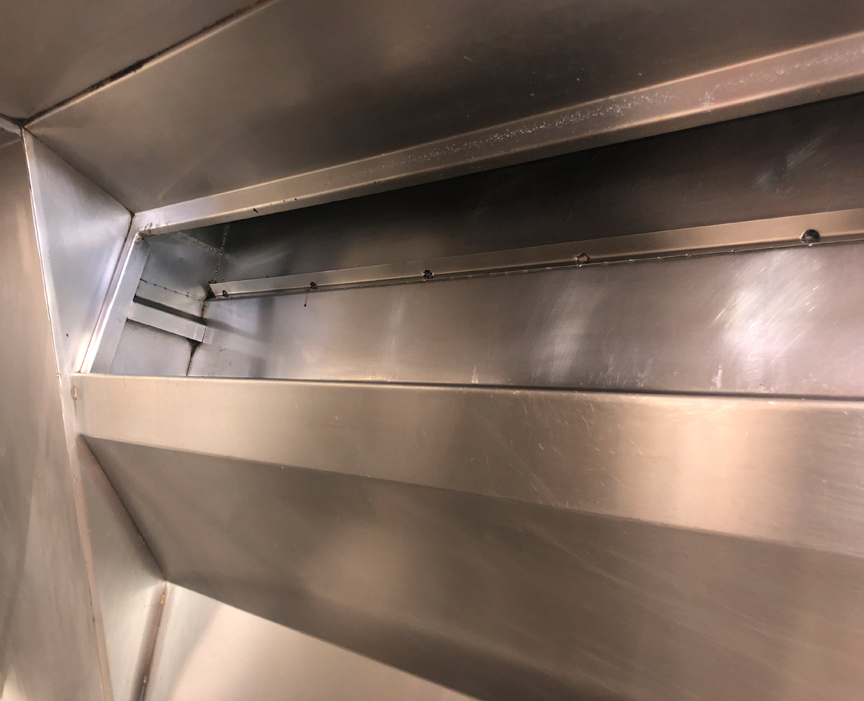
Canopy interior before and after cleaning. Note the complete removal of grease from all surfaces.
Step 4: Full-length ductwork cleaning
This is the most critical step and the one that separates a proper clean from an inadequate one.
Technicians open every access panel along the duct run and clean the interior surfaces of the ductwork, so grease and combustible residues are removed to the extent reasonably practicable. This involves mechanical scraping, chemical degreasing, and in some cases rotary brush cleaning, depending on the type and extent of the build-up.
Every section of ductwork is cleaned. Risers, horizontal runs, bends, junctions: all of it. Horizontal ducting and bends into the vertical risers are the priority as this is where debris and pooling most often accumulate. Vertical risers, particularly on high rise buildings, should be inspected and where necessary may require special attention (plumbing cameras, elevated work platforms or rope access specialists) depending on the location, size and debris build up in the duct. “During” and “after” photographs are taken at key points along the duct to document the cleaning process through the entire system.
For operators and facility managers, this places an obligation to ensure the provider engaged is appropriately qualified and experienced for the task. While many providers offer kitchen exhaust cleaning, capability can vary significantly. Indicators of competency may include a strong track record across similar sites, established long-term client relationships, and relevant industry training or memberships. For example, some providers maintain affiliations with organisations such as IKECA or NADCA, which support structured training and best practice methodologies.
Inside the ductwork: grease and combustible residues removed. Every surface cleaned to the extent reasonably practicable.
Step 5: Exhaust fan cleaning
The exhaust fan is accessed (usually on the roof) and cleaned: blades, housing, and surrounding areas. Grease accumulation on the fan affects performance and represents a fire spread risk. Cleaning the ducting just below the fan and on the internal components is often skipped or done to a limited extent as some providers focus on kitchen-level components and visible sections of the fan.
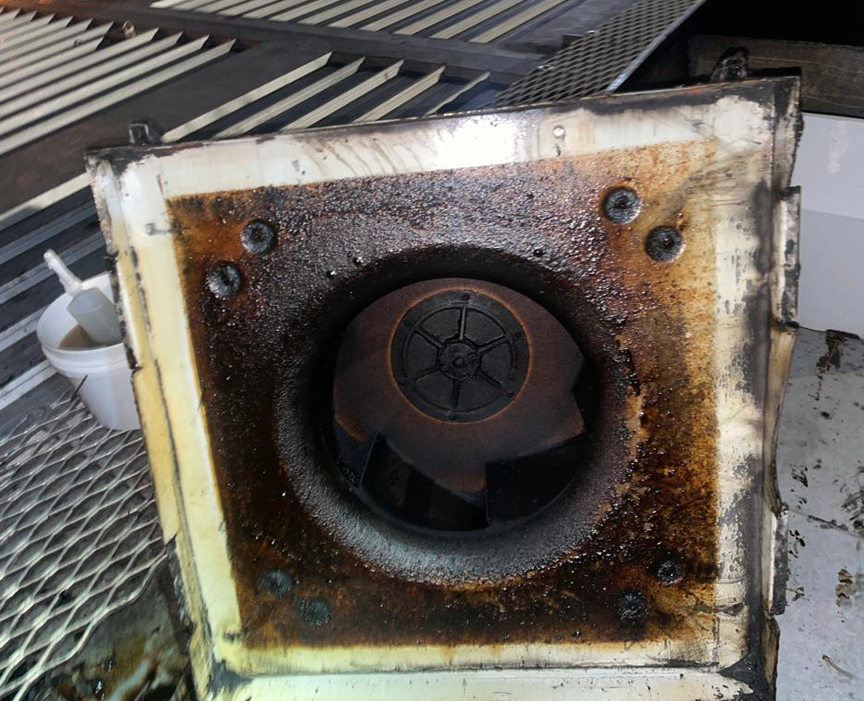
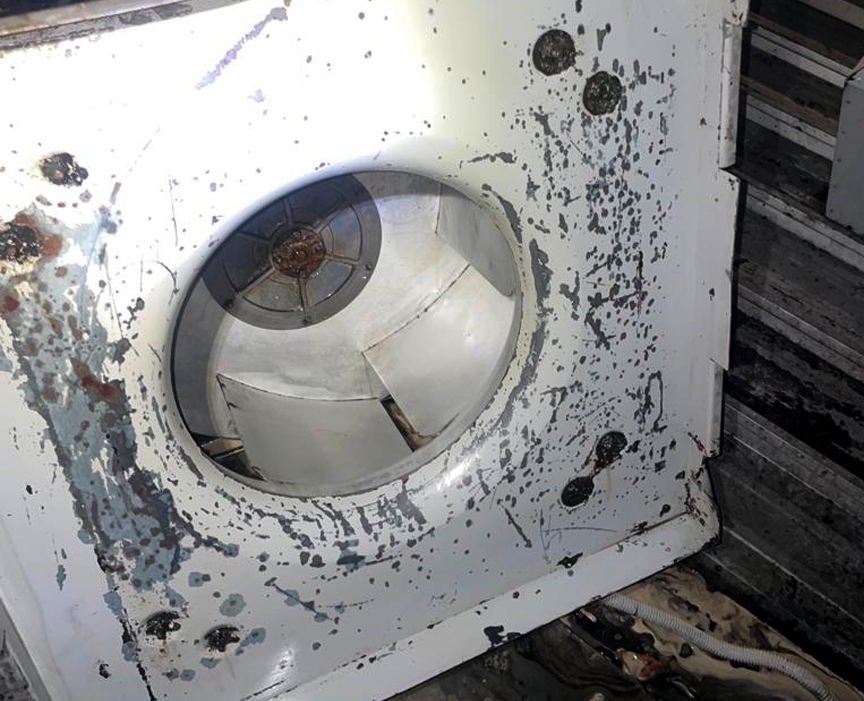
Rooftop exhaust fan before and after cleaning. Heavy grease accumulation like this is a fire risk and reduces fan efficiency.
Step 6: Reassembly and site clean-up
Filters are reinstalled, access panels secured, and all protective coverings removed. The kitchen is returned to operational condition: fans tested, equipment uncovered, surfaces wiped down, work area left clean. If you’re arriving the next morning to find residue, displaced equipment, or mess, the standard of service isn’t where it needs to be.
Step 7: Documentation and compliance certification
“After” photographs are taken of every component of the system, showing the condition post-clean. These photos, combined with the “before” and “during” images, create a complete visual record of the work.
The provider then issues a service report or certificate documenting:
- The date of the clean
- The areas of the system cleaned
- The standard the work was performed to (AS 1851-2012)
- Any areas that were not accessible for cleaning or require attention
- Photographic evidence throughout
It should be in a format that’s easy to file, forward to your insurer, and produce during an audit.
Scope of exhaust system cleaning
Exhaust system cleaning focuses on the removal of grease and contaminants from accessible components of the kitchen exhaust system, including canopies, filters, accessible ductwork, and fans.
It is a cleaning activity only. It does not replace the inspection, servicing, or certification of fire protection systems, which may include items such as fire detection and alarm systems, fire suppression systems (e.g. sprinklers or kitchen suppression systems), and associated control equipment.
These systems must be inspected and maintained by a competent person (and, where required, appropriately licensed) in accordance with AS 1851 and relevant regulatory requirements. Exhaust cleaning may support the performance of fire protection systems, but it is not a substitute for their inspection or maintenance.
From the field
In high-use kitchens, grease accumulation can occur more quickly than expected — particularly where cooking volume has increased over time.
We often see systems where cleaning frequency has not kept pace with usage, leading to significant build-up in ductwork and fans that is not visible from the kitchen.
Get a Kitchen Exhaust Cleaning Quote
Tell us about your site and we’ll provide a tailored quote, including recommended cleaning frequency, full scope of work, and transparent pricing.
Get a Free QuoteIs Your Current Provider Meeting the Standard?
Under AS 1851, inspection and maintenance of fire protection systems must be carried out by a competent person. In practice, this means a provider with the training, experience, and systems required to properly service a complex kitchen exhaust system — not just clean visible surfaces.
Use this checklist to evaluate your current kitchen exhaust cleaning arrangement. It’s designed to be used with any provider, including SAIS Hygiene. If you’re already a client of ours and we’re not meeting any of these standards, we want to know about it. If you’re unsure on the answer to any item, that’s an answer in itself.
System Coverage
Competence
Documentation
Reliability
Workforce
Multi-Site Capability (if applicable)
How to read your results
Ticked every box? Your current provider is doing a thorough job. Hold onto them. A good exhaust cleaning provider is hard to find, and switching for the sake of it doesn’t make sense. If you’ve got a provider who cleans the full system thoroughly, documents everything, manages the schedule, and turns up when they say they will, that relationship is worth protecting.
Ticked most but not all? You may have a provider who does good work but has gaps in their process, perhaps documentation, or frequency alignment, or after-hours availability. It’s worth raising the gaps with them directly. A good provider will welcome the feedback. If they can’t or won’t address it, that tells you something.
Left several unchecked? You’re not alone. Many facility managers and kitchen operators inherit a cleaning arrangement that was set up years ago by someone else, with a provider chosen on price rather than capability. The arrangement continues on autopilot until something goes wrong: a failed inspection, a near-miss, or an insurer asking questions that can’t be answered. If that’s where you are, it’s worth having a conversation about what proper coverage looks like for your operation.
The Multi-Site Challenge (And Why It Changes Everything)
If you manage a single kitchen, the exhaust cleaning challenge is straightforward: find a good local provider, set a schedule, and monitor the results. To be frank, if you’re running one site in one city, you probably don’t need a multi-state provider. A competent local operator who meets the standards in Section 5 will serve you well.
But if you manage multiple sites, whether that’s five QSR locations across Sydney or sixty venues across three states, the challenge compounds significantly. This is where the equation changes.
The compounding compliance risk
Every additional site multiplies your compliance exposure. If one system is non-compliant, you have a problem at one location. If the same gap exists across twenty sites because the same corner is being cut everywhere, you have a systemic compliance failure. The liability implications are proportionally larger.
Multi-site operators face a particularly difficult version of this problem: ensuring that the standard of service at a site in regional Queensland is the same as the standard at a flagship site in Sydney CBD. When you’re not physically present at every clean, consistency is everything.
The problem with multiple providers
Many multi-site operators end up with different providers in different regions. This creates compounding problems: inconsistent documentation formats, varying cleaning standards across sites, and multiplied admin overhead (contracts, invoices, contacts, scheduling). When something goes wrong, you’re the one piecing together which provider was responsible and whether the documentation stacks up.
What a properly managed national program looks like
For multi-site operators, the solution is a single provider with the coverage and systems to manage the entire portfolio: centralised scheduling set per site based on actual cooking operations, consistent standards regardless of geography, a single point of contact, consolidated compliance reporting, and transparent volume-based pricing.
SAIS Hygiene currently manages cleaning programs across 1,000+ commercial kitchen sites, with offices in New South Wales, Queensland, and Victoria and service coverage across NSW, ACT, VIC, QLD, SA, and TAS. The 100% employed staff model (no subcontractors) means the same training, the same methodology, and the same accountability applies at every site.
← Back to topGet a Kitchen Exhaust Cleaning Quote
Tell us about your site and we’ll provide a tailored quote, including recommended cleaning frequency, full scope of work, and transparent pricing.
Get a Free QuoteWhat Owner/Operators Should Do
To manage risk and maintain your system effectively, we recommend:
- Reviewing cleaning frequency based on actual kitchen usage
- Keeping clear records of all cleaning and maintenance
- Ensuring the full system is accessible and able to be cleaned (including ductwork and fans)
- Confirming fire protection systems are inspected separately by qualified providers
- Reviewing insurer requirements periodically
- Acting promptly if grease build-up, reduced airflow, or other issues are observed
Questions to Ask Your Exhaust Cleaning Provider
Not all services are the same. It’s important to understand what is included.
Consider asking:
- Does the service include the full system (hood, duct, and fan)?
- How is cleanliness verified?
- Are before/after photos provided?
- What standard is the system cleaned to?
- Are there any exclusions in the scope of work?
Understanding scope helps ensure expectations are clear.
← Back to topAbout SAIS Hygiene
SAIS Hygiene (SA Industrial Services NSW Pty Ltd) has been providing specialist kitchen exhaust and HVAC cleaning services to Australian commercial kitchens since 2003.
What we do: Kitchen exhaust cleaning, HVAC duct cleaning, exhaust system remediation, HVAC build support, AC systems cleaning, and commercial kitchen deep cleaning.
Who we work with: QSR chains, restaurant groups, pubs and clubs, hotels, shopping centres, healthcare facilities, aged care, schools, and food production facilities, from single-site operators to national portfolios.
Our credentials:
- NADCA members since 2020 (National Air Duct Cleaners Association)
- ASCS-certified technicians (Air Systems Cleaning Specialist)
- All work performed to AS 1851-2012
- CM3 audited safety management
- IKECA members
- 100% employed staff: no subcontractors
Our reach:
- 1,000+ client sites nationally
- Head office: Moorebank, NSW
- Branch offices: Beenleigh, QLD and Laverton North, VIC
- Service coverage: NSW, ACT, VIC, QLD, SA, TAS
- After-hours, weekends, and public holidays available
Trusted by: McDonald’s, KFC, Betty’s Burgers, hundreds of franchisees across multiple brands as well as Australia’s leading hotel and hospitality groups for over 20 years.
Where we’re honest about our limitations: We’re specialists, not generalists. We don’t do general commercial cleaning, pest control, or facilities management. We do kitchen exhaust cleaning, HVAC duct cleaning, and related specialist services, and we focus on doing those exceptionally well. If your need falls outside that scope, we’ll tell you and recommend someone who can help.
Our Accreditations



Trusted by leading brands







Get a Free Assessment
If anything in this guide has raised questions about your current exhaust cleaning arrangement, the simplest next step is a conversation.
SAIS Hygiene offers a free, no-obligation assessment for any commercial kitchen exhaust cleaning requirement, whether that’s a single site or a national portfolio.
Here’s what happens when you get in touch:
There’s no obligation and no pressure. It’s simply a chance to understand your current situation, identify any gaps, and explore whether we can help. We’re happy to answer questions and point you in the right direction, even if that’s not with us.
Get a Kitchen Exhaust Cleaning Quote
Tell us about your site and we’ll provide a tailored quote, including recommended cleaning frequency, full scope of work, and transparent pricing.
Get a Free QuoteDisclaimer
This guide provides general information only and does not constitute compliance or fire safety advice. Requirements may vary depending on your system, usage, and applicable standards. Site-specific advice should be obtained where required.
Phone: 1800 800 235
Website: www.saishygiene.com.au
Email: info@saishygiene.com.au
Head Office: 3 Kelso Crescent, Moorebank, NSW 2170